
When Progress on Diversity Depends on Employer Goodwill, It Can Disappear
Improving cultural and racial diversity in Australian workplaces is often framed as a question of leadership, cultural reform, and organisational commitment. These things matter, but experience shows they are not enough. Diversity, Equity, and Inclusion (DEI) initiatives that rely solely on employer goodwill can be reversed, deprioritised, or quietly abandoned. If DEI advocates are serious, the use of enterprise bargaining and Work Health and Safety (WHS) laws offer the most practical avenue to embed initiatives, strengthen accountability, and enforce commitments. The upcoming round of Australian Public Service (APS) service-wide bargaining provides an opportunity to do this in the context of Federal government agencies.
There is recognition that Australia’s cultural and racial diversity is underrepresented in the APS. While nearly half of Australians have a parent born overseas and an estimated 46% have a non-Anglo-Celtic background according to the 2025 APS Census only 27% of APS employees identified as culturally and linguistically diverse (CALD). Those from non-English speaking backgrounds are less likely to be promoted in the APS regardless of English language proficiency or length of time in Australia. Remuneration data also indicates that CALD employees earn less on average, suggesting these barriers may be compounded for intersectional groups, such as CALD women. Such underrepresentation matters because diverse workplaces are associated with better decision-making and public institutions should reflect the communities they serve.
This cultural and racial diversity skew in the APS is not a surprise. Jobs and Skills Australia’s Gender Economic Equality Study found that CALD representation in occupations had intensified at both the highest and lowest skill levels, most notably in specific high-skill, high-growth occupations in business, health, and IT. In the APS, CALD employees are similarly most represented in job families like IT, accounting, and finance. Yet this diversity is often not reflected in leadership roles, with only 11.8% of the Senior Executive Service (SES) in the APS identifying as CALD (Figure 1). The pattern extends beyond the APS, as demonstrated by the ongoing lack of cultural diversity on ASX 300 boards. These patterns suggest that barriers to progression are not simply a pipeline issue but reflect structural barriers that limit advancement into leadership roles.
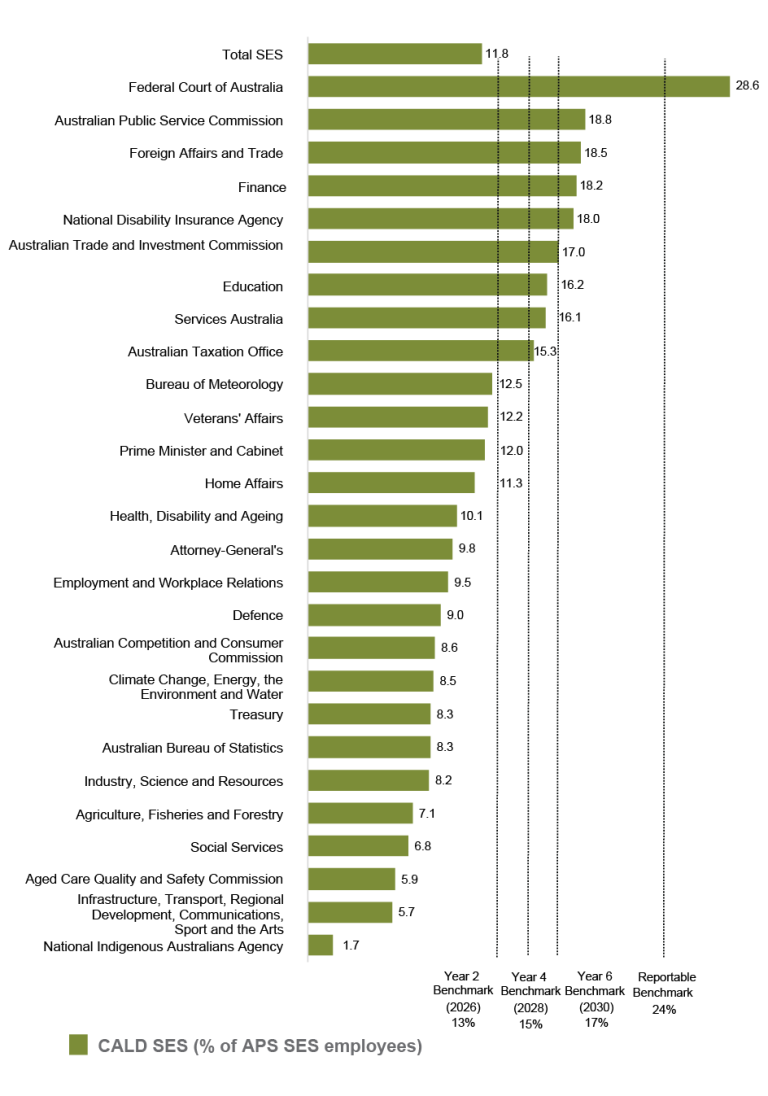
Figure 1: SES cultural and linguistic diversity by APS agency (30 June 2025)
In addition, many culturally and racially diverse public servants report barriers to career progression. A 2023 Community and Public Sector Union (CPSU) report on improving cultural, linguistic, and racial diversity in the APS found that 37.6% of public servants from CALD backgrounds, especially those from non-European backgrounds, experienced barriers in career progression and professional developments. Recent analysis of APS employment data by Australian National University researchers also points to an "Asian penalty" in career advancement. This data suggests the persistence of a "bamboo ceiling" that continues to limit career progression opportunities for many Asian-Australians in the APS.
Racism also remains a significant workplace issue. CPSU’s report found that a third (31.8%) of respondents experienced discrimination and racism in their respective workplaces but that four in five (79.8%) did not report the behaviour to their respective agency. The low rate of reporting points to a lack of confidence that complaints will be addressed effectively, a point made by the Race Discrimination Commissioner, and highlights the importance of stronger accountability mechanisms.
While the adoption of a CALD APS Employment Strategy is welcome, including a 24% CALD target in SES leadership in the APS at an agency level, more needs to be done. Despite improvements, much progress remains aspirational and reliant on the goodwill of agencies. The limitations of this aspirational approach are clear within the global pushback against DEI initiatives which has had flow-on effects domestically. Consulting firm Accenture’s scrapping of DEI programs and ABC’s ending of paid membership to diversity groups are two examples of how that progress can easily go backwards in Australia. When diversity initiatives depend solely on employer goodwill, they can be weakened, deprioritised or removed altogether as leadership priorities change.
The positive case for increased diversity and representation in workplaces needs to be made, but it alone is not enough. So what else can be done?
Australia’s industrial relations system provides an underutilised avenue. For many workplaces, enterprise bargaining provides the best immediate avenue to move beyond rhetoric about DEI and to ensure tangible, lasting gains.
Adoption of the Australian Human Rights Commission’s proposed National Anti-Racism Framework (the Framework) through enterprise bargaining needs to be a priority. Importantly, enterprise agreements can transform commitments from voluntary aspirations into enforceable workplace rights and obligations. The Framework has a range of workplace and employment recommendations including the:
Development and implementation of internal workplace anti-racism strategies for all employers;
Mandatory cultural safety and anti-racism training for all workers;
National standards for reporting workplace racism; and
Strategies for the recruitment and retention of staff from First Nations and other negatively racialised backgrounds, particularly in leadership and senior roles.
Drawing on the example of the Respect@Work reforms to address workplace sexual harassment, implementing anti-racism measures in Australia is achievable. In the APS, this could include the provision of anti-racism training for employees especially managers and senior leaders, the involvement of employees and unions in developing measurable indicators, monitoring and evaluation processes, as well as the creation of a reporting mechanism in agencies for incidents of racism and introduction of corresponding actions.
With the APS about to begin service-wide bargaining, DEI advocates have the opportunity to demonstrate what is industrially possible. The APS can play a role as a model employer through the implementation of the Framework’s relevant workplace and employment recommendations. Having said this, the process will require enforceable monitoring and compliance. Without meaningful enforcement through enterprise agreements, there is a risk that commitments remain symbolic rather than driving measurable workplace change.
Previous rounds of enterprise bargaining have shown what gains can be made on the cultural diversity front. The last round of APS service-wide bargaining led to three days paid cultural leave for all APS employees. Enterprise bargaining has also enabled wins such as the provision of language allowances, recognition of kinship obligations and the right for First Nations public servants to request the ability to work from Country.
For the CPSU, its service-wide bargaining claim for the APS this year includes the adoption of the National Anti-Racism Framework and improving access to paid cultural leave. A bargaining claim is a list of proposed improvements for the next enterprise agreement, which serves as the starting point for negotiations. Embedding such measures in enterprise agreements would help ensure surviving changes in organisational leadership and government priorities.
Beyond enterprise bargaining, there is also increasing recognition that racism is a psychosocial hazard that needs to be addressed under WHS laws. Employers have a positive duty to eliminate the risk of racism so far as reasonably practicable. This duty reflects growing recognition that racism can cause significant psychological harm and undermine workers' health, safety, and wellbeing.
In the APS, psychosocial safety could be supported through service-wide standards for preventing and responding to racism, including consistent reporting and complaints processes, a definition of racism that explicitly encompasses interpersonal, institutional, systemic and structural forms of racism, and access to additional Employee Assistance Program support where necessary. Such measures would provide practical mechanisms to prevent discrimination and psychosocial harm and ensure existing WHS mechanisms can prevent and respond to workplace racism.
Under model WHS laws, elected Health and Safety Representatives (HSRs) have legal powers and functions to undertake this role, including representing employees and abilities to issue provisional improvement notices where non-compliance is suspected, and directing the cessation of unsafe work.
Engagement in collective bargaining through relevant trade unions and advocacy through HSRs will enable the embedding of rights, obligations, and accountability mechanisms directly into workplaces, making them legally enforceable rather than optional. If we are serious about improving cultural and racial diversity in our workplaces, we must move beyond statements of intent and use Australia’s industrial laws to ensure lasting change.
Osmond Chiu is the Senior Policy and Research Officer at the Community and Public Sector Union. He is also a Research Fellow at the Per Capita think tank.
